Toronto to Halifax
A real GYST plan: 1,810 km over three days, with two overnight stops.
Read the guide
With kids in the car, a charging stop is also a washroom, snack and stretch stop. Here is how to plan the trip around that.
In our real GYST plans, a fast-charging stop runs from about 13 to 26 minutes.
That is about the length of a washroom break and a snack, so what sits next to the charger decides whether the stop works. At the Ivy ONroute in Napanee, food, coffee and washrooms are a minute’s walk from the chargers.
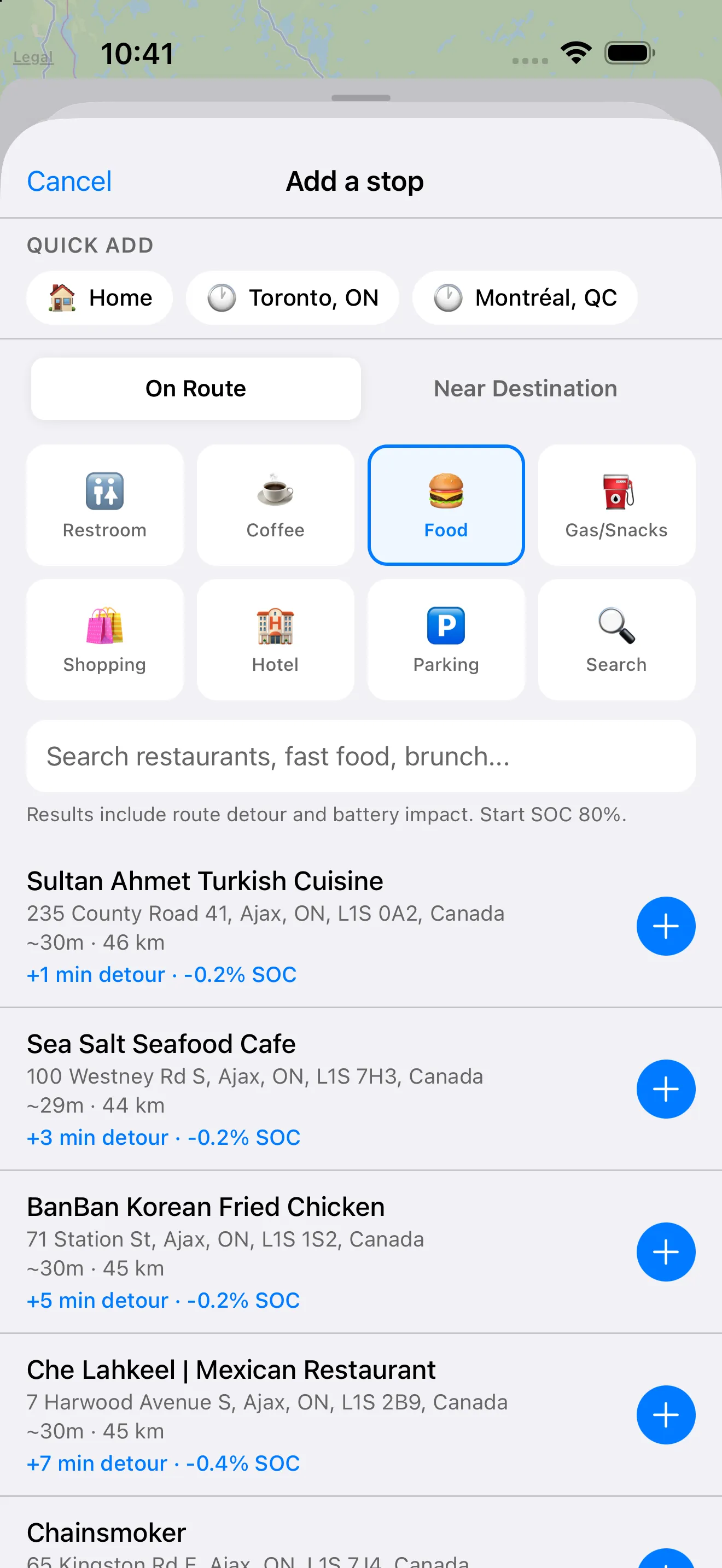
In GYST, Add a stop searches along your route for restrooms, coffee, food, gas and snacks, shopping, hotels and parking. Each result shows the detour time and what the detour does to your battery. Choose On Route to stay on the highway, or Near Destination for the end of the trip.
The site matters more than the network. A charger at a highway service centre such as an ONroute has washrooms and food close by. A charger in a quiet parking lot may have neither.
Each stop in a plan names its network, such as Ivy or Petro-Canada. In Network Preferences you can add your memberships, mark networks as preferred and mark networks to avoid, so the plan leans toward the ones you can pay for and away from the ones that gave you trouble.
Set how long you want to drive each day. The daily driving time in GYST runs from 4 to 12 hours, and the plan splits a long trip into days with charging near each overnight stop. With kids, a shorter day can be the better setting.
Our Toronto to Halifax plan used about 7 hours of driving a day: three days, seven daytime charging stops and two overnights, about $131 estimated for the whole trip. Each overnight stop links to places to stay and overnight charging nearby.
Book hotels with charging where you can. Charging overnight means you start each day nearly full and skip a morning stop.
Open the plan and look at how long each charging stop is, what is within a short walk of it, and what time you arrive at each overnight stop. If a stop has nothing nearby, add one that does.
GYST can’t fix a broken charger, and public charger status can be out of date. Stop lengths and costs are estimates, so on a long leg it is worth knowing where a second charger is.
GYST is free to plan with on iPhone. Pick your exact vehicle, enter where you are going and GYST builds the route with compatible charging stops, charging time and an estimated cost for the whole trip.
It depends on the route and on what is next to each charger. A highway service centre with washrooms and food nearby, such as an ONroute, suits kids better than a charger in an empty parking lot. GYST lets you set preferred and avoided networks and shows what is near each stop.
In our real GYST plans, fast-charging stops ran from about 13 to 26 minutes. Your car, your battery level and the charger change that.
Stop times, costs and charger details are estimates and change with your car, starting charge, weather and traffic. Always check your plan and charger status before you leave.
A real GYST plan: 1,810 km over three days, with two overnight stops.
Read the guideA real GYST plan: 550 km and one 26-minute stop near Napanee.
Read the guideA real GYST plan: 813 km and three stops totalling 50 minutes.
Read the guideA real GYST plan: 488 km, one 18-minute stop and the Saguenay ferry.
Read the guideA real plan split into charger cost and home charge: $30.64 for Toronto to Montréal.
Read the guideGet GYST news, product updates, EV travel tips and occasional offers.